2015年9月29日星期二

Basic Knowledge About Media Converter

Over the years, there has been a growing popularity of Ethernet networks, resulting in the increasing use of Ethernet switches in the network infrastructure. But there is problem that the majority of Ethernet switches on the market today are available only with either 10Base-T or 100Base-TX interfaces (i.e., RJ-45). And on the other hand, in order to meet the needs of longer distance transmission and immunity to electrical interference or eavesdropping/interception, fiber cable has been used on a large scale. Since the entire network is not all twisted pair, the problem of how to interconnect disparate cabling types to the switch must be solved. As a result, media converter, a device which can convert RJ-45 to one of the fiber types in use, has been designed.
What is a Media Converter?
Media converter is a simple networking device that enables you to interconnect networks or network devices with different speeds, operation types, modes and media types. And the most common type usually works as a transceiver, converting the electrical signals in copper unshielded twisted pair (UTP) network cabling to light waves used for fiber optic cabling. It is essential to have the fiber optic connectivity if the distance between two network devices is greater than the copper cabling's transmission distance. Since media converters are IEEE compliant devices, they implement IEEE data encoding rules and Link Integrity Test.
Media Converter
Types of Media Converter
Generally, there are two types of media converter. One type is copper to fiber media converter, another is fiber to fiber media converter. And the illustration of each type will be given as follows.
Copper to fiber media converter - It is a compact device that provides seamless integration of copper and fiber cabling in Enterprise, Government and Service Provider networks. Also, it can be divided into two types, too. They are Ethernet copper to fiber media converter and TDM copper to fiber media converter. Ethernet copper-to-fiber media converter provides connectivity for Ethernet, Fast Ethernet, Gigabit and 10 Gigabit Ethernet devices. Some of it support 10/100 or 10/100/1000 rate switching, enabling the integration of equipment of different data rates and interface types into one seamless network.
As to TDM copper to fiber media converter, the common used types are T1/E1 and T3/E3 converters, providing a reliable and cost-effective method to extend traditional TDM (Time Division Multiplexing) telecom protocols copper connections using fiber optic cabling.
Fiber to fiber media converter - This media converter type can provide connectivity between multimode and single-mode fiber, or between dual fiber and single-fiber. What is more, it can support conversion from one wavelength to another. Fiber to fiber media converter is normally protocol independent and available for Ethernet, and TDM applications.
Benefits of Media Converter
Nowadays, media converter plays an important role in multi-protocol and mixed-media networks. In general, media conversion can deliver the following benefits for your network environment:
Cost Reduction - Compared with the hybrid media switches, the cost of media converters with cost-effective Ethernet switches is much lower. What is more, the two devices can do the same job. This type of media converter solution can cost significantly less than that relies on higher-layer devices such as routers or switches.
Flexibility and Simplification - It is of much flexibility for media converter to combine copper with 850 nm and 1300 nm multimode fiber and 1310 nm and 1550 nm single-mode fiber. In addition, With protocol transparency, it can be applied in anywhere in the local network or remote network whether it's a LAN or the WAN environment.
Ease of Use and High Availability - Configuring and installing redundant solution of media converter is much easier to handle and to manage than higher-layer devices. And it will makes the troubleshooting easier if you add management functions to the media converter.
Since media converter has so many advantages, it can support advanced bridge features – including VLAN, Quality of Service prioritization, Port Access Control and Bandwidth Control – that facilitate the deployment of new data, voice and video to end users. In a word, media converter does more than convert copper-to-fiber and convert between different fiber types. It can also provide all these sophisticated switch capabilities in a small, cost-effective device.
Originally published at http://www.chinacablesbuy.com/basic-knowledge-about-media-converter.html

2015年9月25日星期五

Guide to Cat5 Cable

UTP is short for "unshielded twisted pair". It's a kind of cable types with one or more pairs of twisted insulated copper conductors contained in a single sheath. UTP cables contain several different categories such as Category 3, Category 4, and Category 5. The word "Category" is abbreviated to "Cat". So Category 3 cable is Cat3 cable and Category 5 cable is Cat5 cable. They are different in the electrical performance criteria. Cat5 cable is the most popular UTP in the today’s computer networking. This article will introduce Cat5 cable.
Structure & Features
Inside Cat5 cable, there are 4 wire pairs. The four wire pairs are distinguished by the color of the insulation. The four colors are orange, green, blue and brown. Each pair has a common theme. One wire in the pair is a solid or primarily solid colored wire and the other is a primarily white wire with a colored stripe. For example, orange is for the solid colored wire and White/Orange for the striped cable. The color code shall be as follows:


e 4 wire pairs of Cat5 cable are carefully twisted. The twists of Cat5 are extremely important. The tighter the twists, the greater the signal integrity. With tighter twists, interference received by the cable is more likely to affect both wires in a pair equally, resulting in no change in the difference between them. This keeps greater data capacity over long distances. Besides, the tighter twists also suppress noise created by the cable because the magnetic field from one wire is canceled by the other, making it less prone to interfering with other cables.
Cat5 cable
Advantages and Disadvantages
Most computer users tend to choose Cat5 cable for their network. That’s because Cat5 cable is cheap. It’s also ideal for a variety of applications, such as computer networks and telephone wiring. And it can reach high-transfer rates. Cat5 cable provides performance of up to 100 MHz and is suitable for 10BASE-T and 100BASE-TX (Fast Ethernet). However, Cat5 cable gradually looses its advantage in the constantly advancing environment of technology. The data transfer through Cat5 cable is limited. It can only handle 100 M per second, and thus is not as effective for larger corporate networks or for any process that requires large data streams such as in modern television transfers.
Comparison with Other UTPs
To meet the high bandwidth needs, Cat5E, Cat6, Cat7 are recommended to the market. Cat5E is an enhanced version of Cat5 to support Gigabit speed which is ten times faster than Fast Ethernet. Cat6 cable is the next step of Cat5E. Compared with Cat5 cables, Cat6 provides lower crosstalk, a higher signal-to-noise ratio, and is suitable for 10GBASE-T (10-Gigabit Ethernet). Cat7 cable is backwards compatible with Cat5 and Cat6 Ethernet. Cat7 has more strict specifications for crosstalk and system noise than Cats. As time goes on, Cat8 cable is provided in the market to satisfy the 40G Ethernet (40GBASE-T).
From the above, with low cost and multiple applications advantages, Cat5 once has been the most common UTP. As higher bandwidth is needed, people tend to other UTPs such as Cat5E, Cat6, Cat7 and CAT8. So guess what kind of twisted pair cabling will appear next? The enhanced Cat8? Or Cat9? There is no exact answer. But the certainty is that the research on cabling work will never stop. And there will be optimized cables to meet the high bandwidth requirements.
Originally published at http://www.china-cable-suppliers.com/guide-to-cat5-cable.html

2015年9月18日星期五

Why the Future of Active Optical Cable Is Bright?

Driven by the demand for more bandwidth for data center, networking is challenging interconnect technologies like Ethernet, Infiniband, Fibre Channel, and Serial-Attached SCST (SAS). Transceivers such as SFP+, QSFP+ or CXP can accept a passive copper-based cable for lengths of 5-7 meters or an actively copper-based cable for lengths up to 15 meters. To seek lower cost, lower power consumption and lower link latency over longer distances, active optical cable (AOC) emerged.
AOC is a cabling technology that accepts the same electrical inputs as a traditional cooper cable. But it uses optical fiber to joint the connectors terminated on each end of the cable. AOC uses electrical-optical conversion on the cable ends to improve speed and data transmission distance of the cable not sacrificing compatibility with standard electrical interfaces.
Active-Optical-Cable
Nowadays, the AOC market is fast growing. How does this happen? Then the following will tell a few advantages of AOC by comparing it with copper cable and optical transceiver.
Compared With Copper Cable

  • Lighter weight 
    Compared with copper cable which has existed in the market for decades, AOC is lighter. For example, five meters of copper cable weighs about one kilogram. Ten meters of AOC weighs less than 150g. The weight difference is obvious. Thus, AOC has fewer chances of damage to switch ports. The lighter and thinner optical cables are easy to manage and maintain and requires less space. Besides, it allows better airflow for cooling and has lower power consumption.
  • Longer Distance 
    The other key characteristics of AOC is active. That’s also the big difference from copper cable. Passive copper will suffer excessive bit error rates when the distance is beyond five meters. AOC is in bit error rates over distance. And it can operate reliably over the distance up to 100 meters. Some AOC products can even extend the reach to 1 km.
Compared With Optical Transceiver

As the name implies, AOC comes with optical connectors on each end that provide electrical-optical conversion and optical transmission. So users can remove the pluggable copper-based transmission device (usually either a CX-4 or QSFP) and plug in the active cables transceiver/connector, whose form factor mirrors that of the copper device it replaces. Compared with the transceiver products, AOC can avoid some of the obstacles that fiber has encountered in data centers. What’s more, it has much greater simplicity and reliability, as it’s factory terminated. And there is no risk of mis-matching polarities, dirt entering the assemblies, or different manufacturers’ tolerance mismatching.
Because of these advantages, the demand for the AOC is increasing as an alternative to copper cable. Some vendors such as Fiberstore have rushed to develop products to meet this hot spot. Fiberstore keeps improving its product line of AOC in order to better satisfy the application of 10G, 40G to 100G Ethernet. At present, there are a variety of AOCs in the market, such as 10GbE SFP+ AOCs, 40Gbps QSFP+ AOCs and 120G CXP AOCs.
The market is expected to grow to just under $100 million and 450,000 units by 2015 according to some forecasts. The increasing growth in commercial data centers and the advent of high speed transmission will make AOCs achieve sales of around US $1 billion by 2018 that means the future of AOCs is bright.
Originally published at http://www.china-cable-suppliers.com/why-the-future-of-active-optical-cable-is-bright.html

2015年9月8日星期二

A Cost-effiective Solution - Cisco Compatible SFP

According to the report of Gartner, Cisco has taken up almost half of the global network equipment market share (totally $38 billion), ahead of other competitors in the telecommunication industry. To a large extend, it is the switches’ market share that attributes to this success. Cisco SFP is the small form factor pluggable module that is usually plugged into the switch. But its price is very high, even up to thousands of dollars. The highly cost is the reason why many customers hesitate to buy it. So in this case, in order to offer a cost-effective solution for you, Cisco compatible SFP in Fiberstore comes around.

Why Choose Fiberstore

Cisco compatible SFP offered by Fiberstore are the most cost-effective standards-based SFP modules fully compatible with Cisco switches & routers. The main advantage of Cisco compatible SFP over Cisco SFP is its cost, which makes it become the cost-effective solution. Here we are going to give a price comparison by taking some examples.

Model Number Price of Cisco compatible SFP Price of Cisco SFP
GLC-T $16.00 $ 395.00
GLC-LH-SMD $7.00 $ 995.00
GLC-LH-SM $7.00 $ 995.00
GLC-SX-MM $6.00 $ 500.00

With this great advantage, Fiberstore has become one of the best-sellers in this industry. What is more, besides the above kinds, various kinds of Cisco Compatible SFPs with good quality and service are also offered here.

Features & Applications of Fiberstore Cisco Compatible SFP

The capacity of Fiberstore Cisco compatible SFP modules is as good as Cisco SFP. They are both of low-power consumption, operating on Cisco switches steady. Generally, there are three kinds of Cisco compatible SFP modules designed to used for three main applications. They are Fast Ethernet SFP, Cisco Gigabit Ethernet SFP and WDM SFP. Next, each application will be given a brief description.

Fast Ethernet SFP - Fast Ethernet SFP comes in six configurations which can be described as the Cisco 100BASE-X SFP. It is a hot-swappable input/output device that plugs into Fast Ethernet ports, dual-rate Fast/Gigabit Ethernet ports, or Gigabit Ethernet ports of a Cisco switch or router, linking the port with the fiber cabling network. One of its configuration is 100BASE-FX SFP, operating on ordinary multimode fiber optic (MMF) link spans up to 2 kilometers long. But there is a point you should note that Cisco offers two products for 100BASE-FX. One is GLC-FE-100FX is for 100Mbps Ethernet ports, and the other one is GLC-GE-100FX is for Gigabit Ethernet ports. Both products can be found in Fiberstore with compatible solution.
100BASE-FX SFP

Gigabit Ethernet SFP - SFP for Gigabit Ethernet can be described as Cisco 1000BASE-X SFP, which plugs into a Gigabit Ethernet port or slot. Compared with Fast Ethernet SFP, its speed and capacity are better. And currently, it still plays an important part in the telecommunication networks. For example, 1000BASE-SX SFP, which is a cost effective module with high performance, can support dual data-rate of 1.25 Gbps/1.0625 Gbps and 550m transmission distance with MMF.
1000BASE-SX SFP

CWDM & DWDM SFP - The speed of CWDM & DWDM SFP can be up to 10 Gbps, with a full options of wavelength for both CWDM and DWDM applications. They both allow enterprises, companies and service providers to provide scalable and easy-to-deploy Gigabit Ethernet and Fibre Channel services in their networks.
Nowadays, Fiberstore has become one of the leaders in compatible optical transceiver modules global manufacturer and supplier trade. At present, there are a lot of discounts for bulk orders in Fiberstore. For more information, please contact us directly over e-mail sales@fiberstore.com.

Originally published at www.chinacablesbuy.com

2015年8月27日星期四

Are You Familiar with Fiber Optic Coupler?

Optical coupler is the extremely important component in a number of phonics devices and systems that couple or split light through wave-guides or fibers. Fiber optic couplers can be either active or passive devices. The difference between active and passive couplers is that a passive coupler redistributes the optical signal without optical-to-electrical conversion. Active couplers are electronic devices that split or combine the signal electrically and use fiber optic detectors and sources for input and output.
fiber optic coupler
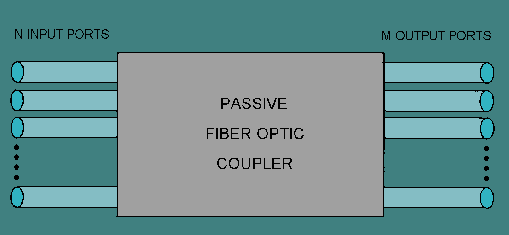
A basic fiber optic coupler has N input ports and M output ports (showed in the above picture) which typically range from 1 to 64. But generally, they are four-port devices and their operation relies on the distributed coupling between two individual waveguides in close proximity, which results in a gradual power transfer between modes supported by the two waveguides. The brief principles of four-ports fiber optic coupler is given in the following picture. If light enters into the port 1, it will be splitted into the output ports between ports 3 and 4. And port 2 functions in the same way. And sometimes, one of port 1 or port 2 is unused, so the fiber optic coupler will act as a Y or T coupler (Y or T stands for the form of transmission route).
brief principles of four-ports fiber optic coupler
As we have known before, fiber optic coupler can couple or split light, so it also can be called fiber optic splitter. In fact, splitter is named for the function of the device, coulper named for its working principle. These days, the most popular types are fused fiber optic couplers and planar lightwave circuit (PLC) splitter.
Fused fiber optic coupler is a kind of fiber optic couplers, which is formed based on fused biconical taper (FBT) technology. Therefore, it is also known as FBT coupler. It can work on three different operating bands such as 850nm, 1310 nm and 1550nm.
Planar Lightwave Circuit (PLC) Splitter is designed to manage the power of optical signals through splitting and routing. It can provide reliable light distribution and is based on planar lightwave circuit technology. Compared with FBT fused coupler of lower cost, PLC splitter has wider operating wavelength range which is from 1260 nm to 1620 nm, and wider temperature range from -40ºC to +85ºC, better uniformity, higher reliability and smaller size.
Currently, fiber optic coupler is widely used in that it can support FTTX (FTTP, FTTH, FTTN, FTTC), passive optical networks (PON), local area networks (LAN), CATV systems, amplifying, monitoring system and test equipment. As a result, fiber optic coupler with good quality is required. Fiberstore can offer you various kinds of fiber optic couplers with good quality, including fused fiber optic coupler and Planar Lightwave Circuit (PLC) Splitter. For more information, you can visit Fiberstore.
Originally published at http://www.chinacablesbuy.com/category/fiber-optic-network

2015年8月24日星期一

PON - a Better Network Solution

When choosing a best fiber architecture for the network, many planners may choose PON today. PON, short for passive optical networks, is a telecommunication network that uses point-to-multipoint fiber to the end-points in which unpowered optical splitters are used to enable a single optical fiber to serve multiple end-points. "Passive" means optical transmission has no power requirements or active electronic parts when the signal is going through the network. It is the core underpinning of fiber optical service.
Introduction of PON
Passive optical network is widely applied in fiber-to-the-curb (FTTC), fiber-to-the-building (FTTB), or fiber-to-the-home (FTTH), which is decided by the places it terminates. Commonly, it is made up of an optical line terminal (OLT) in the central office and a number of optical network units (ONU) near end users. From the picture below, we can get a brief understanding of the working process of it.
First and foremost, the data or the signals in the central office will be transmitted over a single optical fiber without interfered by each other, because encryption can prevent eavesdropping. And then the passive splitter will separate the signals into several optical network units which can be up to 64 units.
PON
Classifications of PON
The first PON systems which is based on Asynchronous Transfer Mode (ATM, or "cell switching") were called "APON". It has been achieved significant commercial deployment and still be applied in someplace today. The "Broadband PON" comes after APON. Typically, these two systems both have downstream capacity of 155 Mbps or 622 Mbps and upstream capacity of 155 Mbps.
And as the technology advanced, there is a growing requirements of higher capacity. As a result, APON and BPON is gradually replaced by GPON. GPON, short for Gigabit-capable passive optical network, is the successor of APON and BPON, and also based on ATM transport. Typically, its capacity of upstream ranges from 622 Mbps to 1.25 Gbps, while the downstream capacity ranges from 622 Mbps to 2.5 Gbps. In today's fiber-to-the-home (FTTH) networks, GPON is most widely deployed, which is generally considered suitable for consumer broadband services for the next 5 to 10 years.
EPON (Ethernet passive optical network) is the rival of GPON, using Ethernet packets instead of ATM cells. It is cheaper to deploy than GPON, but it has not garnered the level of acceptance of GPON.
And WDM PON (wavelength-division multiplexing passive optical network) is a network that combines WDM technology with PON system. It can use wavelength-division multiplexing to split each signal into different branches.
Advantages of PON
Compared with the traditional enterprise network, PON network is obvious superior to it. And there are several advantages of PON.
Energy savings – PON system does not need rack mount switches and other active devices in remote locations so that it can reduce a number of heat generating devices that must be cooled and powered, thereby generating energy savings. Also, there are reduced HVAC (Heating Ventilation Air Conditioning) requirements, since there is no radiant heat with fiber cabling.
Lower cost – Due to lower power consumption, reduction in floor space, and yearly reduced maintenance costs, the enterprise will realize significant operational expense savings over the life of the system of 45-70% over that of a traditional copper based system, as well.
Optimized bandwidth utilization – with dynamic allocation of bandwidth, the system can provide optimized network connectivity to those application and users requiring the greatest bandwidth, while facilitating future proofing.
Now, the Ethernet market becomes more and more popular, so PON is gradually getting into a bright future. With these significant advantages, PON can meet the changing demands of the enterprise network more quickly and easily. And at present, the most popular network systems are GPON and EPON. Fiberstore offers various PON products, including optical line terminals and optical network units, and if you want to deploy your network most efficiently, Fiberstore is your best choice.

2015年8月20日星期四

Introduction of Singlemode Fiber Patch Cable

When signals are transmitted over a long distance, singlemode fiber patch cable which plays a vital part in the remote telecommunication should not be ignored. Singlemode fiber patch cable is a single strand (most applications use 2 fibers) of glass fiber with a diameter of 8.3 to 10 microns, which only transmits single mode on a given operating wavelength. The dispersion in it is little, so that singlemode fiber cable can support Gigabit Ethernet data transfer up to 10 kilometers in distance.
Comparison With Multimode Fiber Patch Cable
Singlemode fiber patch cable which we talked before is one type of fiber patch cable, and another type is multimode fiber patch cable. Different from singlemode fiber patch cable, multimode fiber patch cable can transmit multimode on a given operating wavelength. But what is the main difference between them? And how can we tell them apart?
The main difference between them is the size of their respective cores. Singlemode fiber has a smaller core than multimode’s. As we said before, the diameter of its core is about 8.3 to 10 microns, while the core of multimode fiber is about 50, 62.5 mm or even higher. As a result, the larger core gathers more light in multimode fiber patch cables than singlemode cables, and this light reflects off the core and allows more signals to be transmitted. In a word, the size of the cores determine their nature.
Another difference is the transmission distance. Due to the smaller core, singlemode fiber patch cable has less signal attenuation than multimode fiber patch cable, so that it can be applied for long distance transmission. On the other hand, although multimode fiber patch cable can transmit multimode, the dispersion between modes is large, which would be a limitation for transmission frequency of digital signals. Therefore, multimode fiber patch cable is usually used for short distance transmission.
Types of Singlemode Fiber Patch Cable
According to the different specification, singlemode fiber can be divided into different kinds. In the picture below, there are three specifications which defined the singlemode fiber. They are IEC (short for International Electrotechnical Commission), ITU (short for International Telecommunication Union) and TIA (short for Telecommunications Industry Association). You can have a visual description from this picture.
types of singlemode fiber
In order to help you to have a better understanding of the types of singlemode fiber, we will take G.652 for an example. G.652 covers singlemode NDSF (non-dispersion-shifted fiber), which has no attenuation coefficient in the 1310 nm range. And low water peak fiber has been specifically processed to reduce the water peak at 1400 nm to allow use in that range.
When put into practice, singlemode fiber cable is often connected with connectors to transmit data. For example, LC to ST fiber patch cable is a cable with LC connector on the one end and ST connector on the other end. Also, the connectors to connect the cables have various kinds, such as SC, FC, ect. And if you want to buy these cables with good quality, Fiberstore is a good choice.